
The industrial repair of large-scale, high-stress components is currently undergoing a paradigm shift: away from costly replacement – towards intelligent restoration. The Laser Directed Energy Deposition (DED) process creates a powerful bridge between traditional welding and additive manufacturing. Particularly when combined with bespoke robotic solutions from Reis Robotics, this opens up enormous potential for companies in terms of efficiency, sustainability and process reliability.
The challenge: cost-effective repair of large components
Whether in metal forming, mechanical engineering or heavy industry – large-format components are costly, difficult to source and often critical to the entire production process. Traditional repair methods quickly reach their economic and technical limits in this context:
- High heat input often leads to component warping.
- Limited precision makes complex geometries difficult to achieve.
- Time-consuming manual reworking drives up costs.
- Frequent replacement of parts results in long downtimes.
It is precisely at this interface that the combination of state-of-the-art laser technology, flexible robotics and in-depth process expertise comes into play.
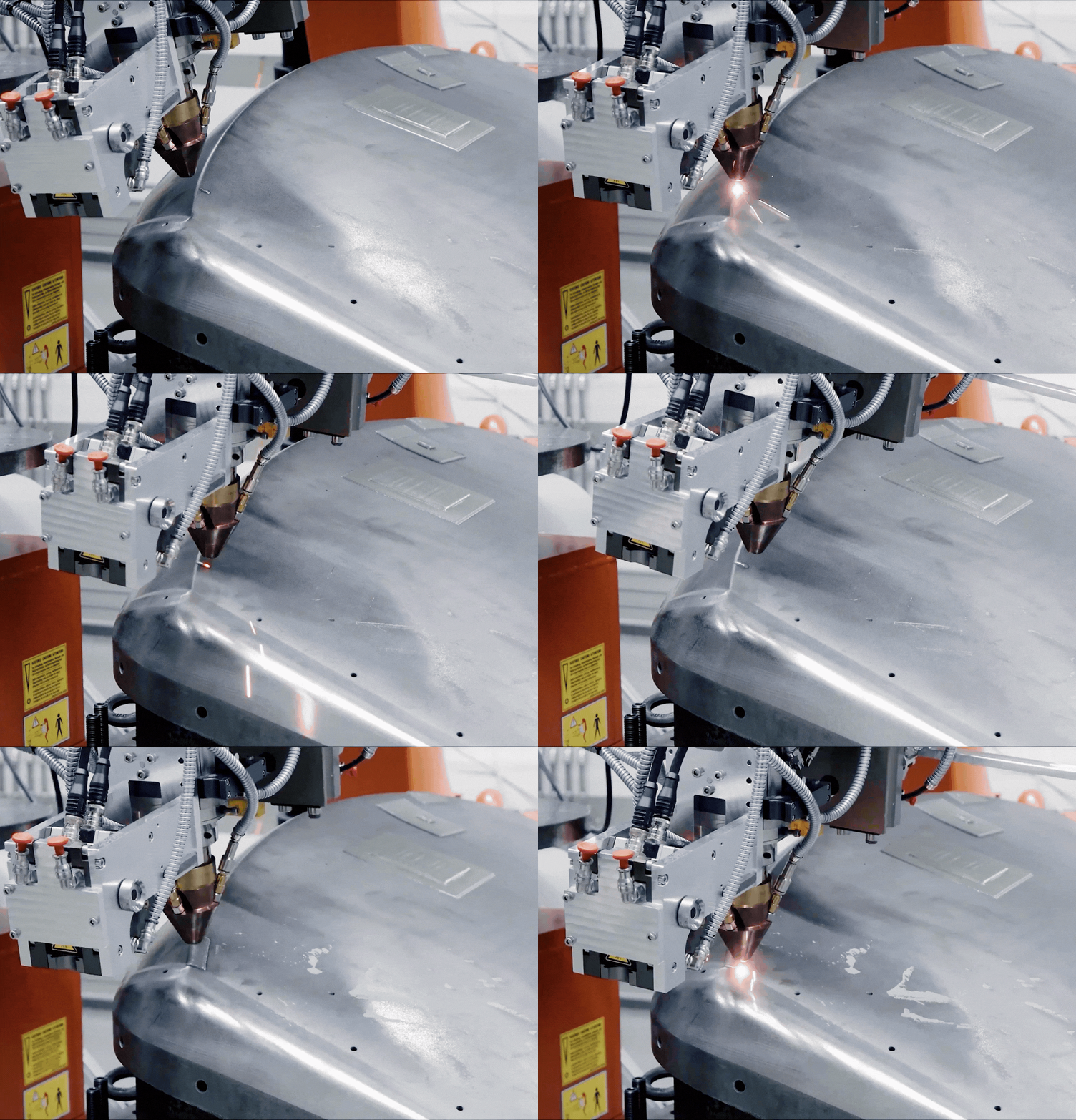
Technological background: From laser cold-wire welding to laser DED
Laser cold-wire welding has already demonstrated how processes can be intelligently combined: a focused laser ensures deep penetration, whilst the cold wire fed in as filler material compensates for tolerances.
This philosophy – combining the best of both worlds – is consistently applied in the DED process:
- A concentrated laser energy input creates a precise melt zone locally.
- Powder or wire is fed in simultaneously as the material.
- The material is deposited layer by layer directly onto the component.
The result is a metallurgically fully bonded, high-precision structural assembly – exactly where it is needed.
Why laser DED is ideal for repair of large components
DED is much more than just a 3D printing manufacturing technology – it is a highly efficient repair strategy. The key practical benefits at a glance:
| Advantage | Practical implications |
| Minimal heat input | Minimal distortion, component structure preserved |
| High precision | Localised material application, results close to the final contour, reduced rework |
| Metallurgical bonding | Extremely durable compared to mechanical coatings |
| High order rates | Ideal for large volumes and bulky components |
Particularly relevant: DED makes it possible to selectively rebuild worn areas rather than replacing the entire component. This offers significant cost savings when dealing with expensive components.
The key to success: automation with Reis Robotics
The real difference lies in implementation on an industrial scale. This is where Reis Robotics’ bespoke systems come into their own. The integration of multi-axis robots and gantry systems, combined with the intelligent integration of laser processes, sensor technology and software, results in scalable solutions. These range from individual cells to fully automated production lines and enable machining capabilities that go far beyond those of conventional machine shops.
Typical areas of application:
- Reconstruction of worn tool surfaces
- Laser-additive repair of forming tools
- Repair of shafts, rollers or moulding tools
- Combination of scanning, path planning and adaptive material deposition
Sustainability as an economic driver
In addition to the technical advantages, DED-based repair directly contributes to resource efficiency. It reduces material consumption, significantly lowers energy use and the carbon footprint, and actively supports circular economy and remanufacturing strategies.
Conclusion: Additive repair is a strategic competitive advantage. It transforms maintenance into high-tech production, ensures higher plant availability and sustainably reduces lifecycle costs.
The shown application was demonstrated in the ProLMD project (www.ProLMD.com) with the project partners.The project has been funded by the German Ministry of Education and Research.